
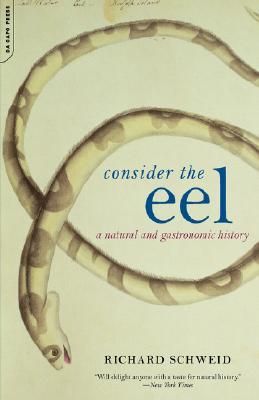
Consider the Eel: A Natural and Gastronomic History




 Share
Share
Journalist Richard Schweid first learned the strange facts of the freshwater eel's life from a fisherman in a small Spanish town just south of Valencia. "The eeler who explained the animal's life cycle to me did so as he served up an eel he had just taken from a trap, killed, cleaned, and cooked in olive oil in an earthenware dish," writes Schweid. "I ate it with a chunk of fresh, crusty bread. It was delicious. I was immediately fascinated."
As this engaging culinary and natural history reveals, the humble eel is indeed an amazing creature. Every European and American eel begins its life in the Sargasso Sea--a vast, weedy stretch of deep Atlantic waters between Bermuda and the Azores. Larval eels drift for up to three years until they reach the rivers of North America or Europe, where they mature and live as long as two decades before returning to the Sargasso to mate and die. Eels have never been bred successfully in captivity.
Consulting fisherfolk, cooks, and scientists, Schweid takes the reader on a global tour to reveal the economic and gastronomic importance of eel in places such as eastern North Carolina, Spain, Northern Ireland, England, and Japan. (While this rich yet mild-tasting fish has virtually disappeared from U.S. tables, over $2 billion worth of eel is still eagerly consumed in Europe and Asia each year.) The book also includes recipes, both historic and contemporary, for preparing eel.
| Author | Richard Schweid |
|---|---|
| Publisher | Da Capo Press |
| Place | United States |
| Year | 2004-03-01 |
| ISBN | 9780306813313 |
| Binding | Paperback |
| Condition | Very Good |
| Comments | Remainder mark on bottom closed pages. |
How we describe the condition of our books
We are very proud of the condition of the books we sell (please read our testimonials to find out more!)
New: Exactly as it says.
As New: Pretty much new but shows small signs of having been read; inside it will be clean without any inscriptions or stamps; might contain a remainder mark.
Very Good: Might have some creases on the spine; no hard cracks; maybe slight forward lean and short inscription inside; perhaps very minor bumping on the corners of the book; inside clean but the page edges might be slightly yellowed.
Good: A few creases on the spine, perhaps a forward lean, bumping on corners or shelfwear; maybe an inscription inside or some shelfwear or a small tear or two on the dustjacket; inside clean but page edges might be somewhat yellowed.
Fair: In overall good condition, might have a severe forward lean to the spine, an inscription, bumping to corners; one or two folds on the covers and yellowed pages; in exceptional cases these books might contain some library stamps and stickers or have neat sticky tape which was used to fix a short, closed tear.
Poor: We rarely sell poor condition books, unless the books are in demand and difficult to find in a better condition. Poor condition books are still perfect for a good read, all pages will be intact and none threatening to fall out; most probably a reading copy only.