
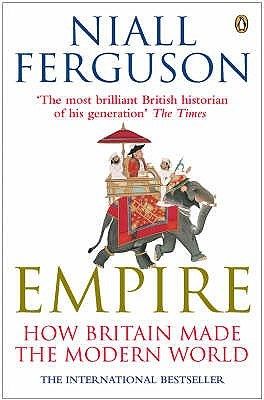
Empire: How Britain Made the Modern World

 Share
Share
A grand narrative history of the world's first experiment in globalization, with lessons for an ever-expanding American Empire--from England's most talented young historian.
The British Empire was the largest in all history, its reach the nearest thing to world domination ever achieved. By the eve of the Second World War, over a fifth of the world's land surface and nearly a quarter of the world's population were under some form of British rule. Yet for today's generation, the British Empire has come to stand for nothing more than a lost Victorian past--one so remote that it has ceased even to be a target for satire. The time is ripe for a reappraisal.
In this major new work of synthesis and revision, Niall Ferguson argues that the British Empire should be regarded not merely as vanished Victoriana but as the very cradle of modernity. Nearly all the key features of the twenty-first-century world can be traced back to the extraordinary expansion of Britain's economy, population, and culture from the seventeenth century until the mid-twentieth--economic globalization, the communications revolution, the racial make-up of North America, the notion of humanitarianism, the nature of democracy. Displaying the originality and rigor that have made him the brightest light among British historians, Ferguson shows that far from being a subject for nostalgia, the story of the Empire is pregnant with lessons for the world today--in particular for the United States as it stands on the brink of a new kind of imperial power based once again on economic and military supremacy.
*Slight forward lean.*
| Author | Niall Ferguson |
|---|---|
| Publisher | Penguin Books |
| Place | London |
| Year | 2004-04-29 |
| ISBN | 9780141007540 |
| Binding | Paperback |
| Condition | Good |
| Comments | Slight forward lean. |
How we describe the condition of our books
We are very proud of the condition of the books we sell (please read our testimonials to find out more!)
New: Exactly as it says.
As New: Pretty much new but shows small signs of having been read; inside it will be clean without any inscriptions or stamps; might contain a remainder mark.
Very Good: Might have some creases on the spine; no hard cracks; maybe slight forward lean and short inscription inside; perhaps very minor bumping on the corners of the book; inside clean but the page edges might be slightly yellowed.
Good: A few creases on the spine, perhaps a forward lean, bumping on corners or shelfwear; maybe an inscription inside or some shelfwear or a small tear or two on the dustjacket; inside clean but page edges might be somewhat yellowed.
Fair: In overall good condition, might have a severe forward lean to the spine, an inscription, bumping to corners; one or two folds on the covers and yellowed pages; in exceptional cases these books might contain some library stamps and stickers or have neat sticky tape which was used to fix a short, closed tear.
Poor: We rarely sell poor condition books, unless the books are in demand and difficult to find in a better condition. Poor condition books are still perfect for a good read, all pages will be intact and none threatening to fall out; most probably a reading copy only.