
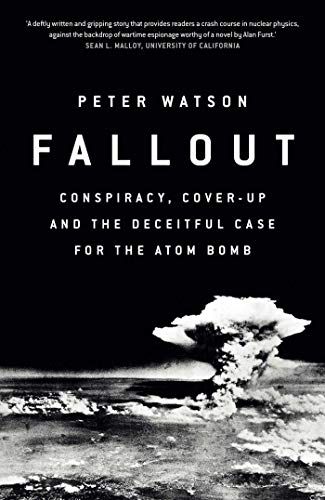
Fallout: Conspiracy, Cover-Up and the Deceitful Case for the Atom Bomb

 Share
Share
Between December 1943 and August 1944, Franklin Delano Roosevelt and Winston Churchill passed up the best chance ever to secure lasting world peace. Instead, they ignited the Cold War superpower rivalry that would dominate the world for the next half century and beyond.
The decision to build the atomic bomb was flawed at every level. The Americans did not tell the UK that the atomic research was compromised by Soviet spies; the British did not tell the Americans that in 1943 they knew for sure that Germany did not have a nuclear bomb program. Neither country admitted to the scientists developing the bomb that it would never be used to counter a German nuclear threat (because there wasn't one). Had they known, many of them would have refused to complete work on the bomb.
The narrative concentrates on a few months in which two atomic physicists tried to influence world affairs - but in very different ways. While Danish physicist and Nobel Prize winner Niels Bohr sought to convince President Roosevelt and Prime Minister Churchill to share their nuclear knowledge with Stalin in a unique peaceful collaboration, nuclear scientist Klaus Fuchs, a German-born Communist and naturalized Briton, was leaking atomic secrets to the Soviets in a rival attempt to ensure parity between the superpowers.
Albert Einstein once said that "politics is more difficult than physics." He was right: this story shows how politicians fatally failed to understand the nature of atomic science and, in so doing, exposed the world needlessly to great danger, a danger that is still very much with us.
| Author | Peter Watson |
|---|---|
| Publisher | Simon & Schuster |
| Place | London |
| Year | 2018-09 |
| ISBN | 9781471164491 |
| Binding | Paperback |
| Condition | Very Good |
| Comments | Slight forward lean. |
How we describe the condition of our books
We are very proud of the condition of the books we sell (please read our testimonials to find out more!)
New: Exactly as it says.
As New: Pretty much new but shows small signs of having been read; inside it will be clean without any inscriptions or stamps; might contain a remainder mark.
Very Good: Might have some creases on the spine; no hard cracks; maybe slight forward lean and short inscription inside; perhaps very minor bumping on the corners of the book; inside clean but the page edges might be slightly yellowed.
Good: A few creases on the spine, perhaps a forward lean, bumping on corners or shelfwear; maybe an inscription inside or some shelfwear or a small tear or two on the dustjacket; inside clean but page edges might be somewhat yellowed.
Fair: In overall good condition, might have a severe forward lean to the spine, an inscription, bumping to corners; one or two folds on the covers and yellowed pages; in exceptional cases these books might contain some library stamps and stickers or have neat sticky tape which was used to fix a short, closed tear.
Poor: We rarely sell poor condition books, unless the books are in demand and difficult to find in a better condition. Poor condition books are still perfect for a good read, all pages will be intact and none threatening to fall out; most probably a reading copy only.