
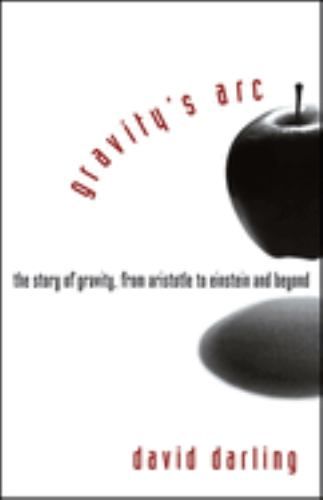
Gravity's Arc: The Story of Gravity from Aristotle to Einstein and Beyond


 Share
Share
How did they do it? How did one of the greatest geniuses who ever lived retard the study of gravity for 2,000 years? How did a gluttonous tyrant with a gold nose revolutionize our view of the solar system? How could an eccentric professor shake the foundations of an entire belief system by dropping two objects from a tower? How did a falling apple turn the thoughts of a reclusive genius toward the moon? And how could a simple patent clerk change our entire view of the universe by imagining himself riding on a beam of light? In Gravity's Arc, you'll discover how some of the most colorful, eccentric, and brilliant people in history first locked, then unlocked the door to understanding one of nature's most essential forces. You'll find out why Aristotle's misguided conclusions about gravity became an unassailable part of Christian dogma, how Galileo slowed down time to determine how fast objects fall, and why Isaac Newton erased every mention of one man's name from his magnum opus Principia. You'll also figure out what Einstein meant when he insisted that space is curved, whether there is really such a thing as antigravity, and why some scientists think that the best way to get to outer space is by taking an elevator.
| Author | David Darling |
|---|---|
| Publisher | Wiley |
| Place | London |
| Year | 2006-05-23 |
| ISBN | 9780471719892 |
| Binding | Hardcover |
| Condition | Very Good |
How we describe the condition of our books
We are very proud of the condition of the books we sell (please read our testimonials to find out more!)
New: Exactly as it says.
As New: Pretty much new but shows small signs of having been read; inside it will be clean without any inscriptions or stamps; might contain a remainder mark.
Very Good: Might have some creases on the spine; no hard cracks; maybe slight forward lean and short inscription inside; perhaps very minor bumping on the corners of the book; inside clean but the page edges might be slightly yellowed.
Good: A few creases on the spine, perhaps a forward lean, bumping on corners or shelfwear; maybe an inscription inside or some shelfwear or a small tear or two on the dustjacket; inside clean but page edges might be somewhat yellowed.
Fair: In overall good condition, might have a severe forward lean to the spine, an inscription, bumping to corners; one or two folds on the covers and yellowed pages; in exceptional cases these books might contain some library stamps and stickers or have neat sticky tape which was used to fix a short, closed tear.
Poor: We rarely sell poor condition books, unless the books are in demand and difficult to find in a better condition. Poor condition books are still perfect for a good read, all pages will be intact and none threatening to fall out; most probably a reading copy only.