
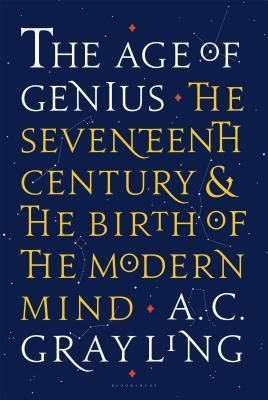
The Age of Genius: The Seventeenth Century and the Birth of the Modern Mind






 Share
Share
What happened to the European mind between 1605, when an audience watching Macbeth at the Globe might believe that regicide was such an aberration of the natural order that ghosts could burst from the ground, and 1649, when a large crowd, perhaps including some who had seen Macbeth forty-four years earlier, could stand and watch the execution of a king? Or consider the difference between a magus casting a star chart and the day in 1639, when Jonathan Horrock and William Crabtree watched the transit of Venus across the face of the sun from their attic, successfully testing its course against Kepler's Tables of Planetary Motion, in a classic case of confirming a scientific theory by empirical testing.
In this turbulent period, science moved from the alchemy and astrology of John Dee to the painstaking observation and astronomy of Galileo, from the classicism of Aristotle, still favoured by the Church, to the evidence-based, collegiate investigation of Francis Bacon. And if the old ways still lingered and affected the new mind set – Descartes's dualism an attempt to square the new philosophy with religious belief; Newton, the man who understood gravity and the laws of motion, still fascinated to the end of his life by alchemy – by the end of that tumultuous century 'the greatest ever change in the mental outlook of humanity' had irrevocably taken place.
*As new; unread.*
| Author | AC Grayling |
|---|---|
| Publisher | Bloomsbury |
| Place | London |
| Year | 2016 |
| ISBN | 9781408870389 |
| Binding | Paperback |
| Condition | Good |
| Comments | Some damage on spine |
How we describe the condition of our books
We are very proud of the condition of the books we sell (please read our testimonials to find out more!)
New: Exactly as it says.
As New: Pretty much new but shows small signs of having been read; inside it will be clean without any inscriptions or stamps; might contain a remainder mark.
Very Good: Might have some creases on the spine; no hard cracks; maybe slight forward lean and short inscription inside; perhaps very minor bumping on the corners of the book; inside clean but the page edges might be slightly yellowed.
Good: A few creases on the spine, perhaps a forward lean, bumping on corners or shelfwear; maybe an inscription inside or some shelfwear or a small tear or two on the dustjacket; inside clean but page edges might be somewhat yellowed.
Fair: In overall good condition, might have a severe forward lean to the spine, an inscription, bumping to corners; one or two folds on the covers and yellowed pages; in exceptional cases these books might contain some library stamps and stickers or have neat sticky tape which was used to fix a short, closed tear.
Poor: We rarely sell poor condition books, unless the books are in demand and difficult to find in a better condition. Poor condition books are still perfect for a good read, all pages will be intact and none threatening to fall out; most probably a reading copy only.