
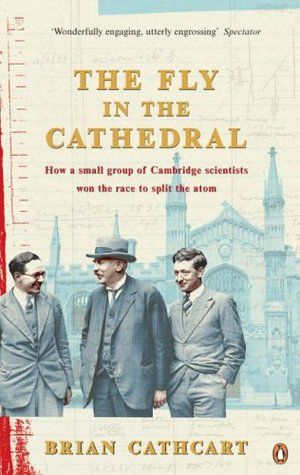
The Fly in the Cathedral: How A Small Group Of Cambridge Scientists Won The Race To Split The Atom

 Share
Share
If you want to understand how something works, you can dismantle it and study its pieces. But what if the thing you're curious about is too small to see, even with the most powerful microscope? Brian Cathcart's The Fly in the Cathedral tells the intriguing story of how scientists were able to take atoms apart to reveal the secrets of their structures. To keep the story gripping, Cathcart focuses on a time (1932, the annus mirabilis of British physics), a place (Cambridge's Cavendish Laboratory), and a few main characters (Ernest Rutherford, the "father of nuclear physics," and his protégés, John Cockcroft and Ernest Walton).
Rutherford and his team knew that the long-accepted atomic model was held together by nothing more than trumped-up math and hope. They hoped to find out what held oppositely charged protons and electrons together, and what strange particles shared the nucleus with protons. In a series of remarkable experiments done on homemade apparatus, these Cambridge scientists moved atomic science to within an inch of its ultimate goal. Finally, Cockcroft and Walton--competing furiously with their American and German peers--put together the machine that would forever change history by splitting an atom. The Fly in the Cathedral combines all the right elements for a great science history: historical context, gritty detail, wrenching failure, and of course, glorious victory. Although the miracles that occurred at Cambridge in 1932 were to result in the fearful, looming threat of atomic warfare, Cathcart allows readers to find unfiltered joy in the accomplishments of a few brilliant, ingenious scientists.
| Author | Brian Cathcart |
|---|---|
| Publisher | Viking |
| Place | London |
| Year | 2004 |
| ISBN | 9780670883219 |
| Binding | Hardcover |
| Condition | Very Good |
| Dustjacket Condition | Very Good |
| Comments | Inscription in black on first free page. |
How we describe the condition of our books
We are very proud of the condition of the books we sell (please read our testimonials to find out more!)
New: Exactly as it says.
As New: Pretty much new but shows small signs of having been read; inside it will be clean without any inscriptions or stamps; might contain a remainder mark.
Very Good: Might have some creases on the spine; no hard cracks; maybe slight forward lean and short inscription inside; perhaps very minor bumping on the corners of the book; inside clean but the page edges might be slightly yellowed.
Good: A few creases on the spine, perhaps a forward lean, bumping on corners or shelfwear; maybe an inscription inside or some shelfwear or a small tear or two on the dustjacket; inside clean but page edges might be somewhat yellowed.
Fair: In overall good condition, might have a severe forward lean to the spine, an inscription, bumping to corners; one or two folds on the covers and yellowed pages; in exceptional cases these books might contain some library stamps and stickers or have neat sticky tape which was used to fix a short, closed tear.
Poor: We rarely sell poor condition books, unless the books are in demand and difficult to find in a better condition. Poor condition books are still perfect for a good read, all pages will be intact and none threatening to fall out; most probably a reading copy only.