
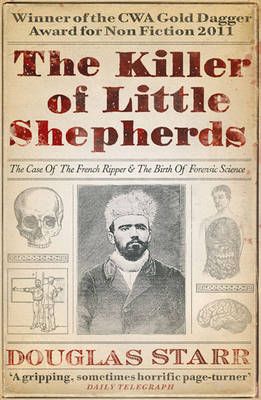
The Killer of Little Shepherds: The Case of the French Ripper and the Birth of Forensic Science






 Share
Share
At the end of the nineteenth century, serial murderer Joseph Vacher, dubbed "The Killer of Little Shepherds," terrorized the French countryside. He eluded authorities for years-until he ran up against prosecutor Emile Fourquet and Dr. Alexandre Lacassagne, the era's most renowned criminologist. The two men typified the Belle Epoque, a period of immense scientific achievement and fascination with its promise to reveal the secrets of the human condition.
With high drama and stunning detail, Douglas Starr recounts the infamous crime and punishment of Vacher, interweaving the story of how Lacassagne and his colleagues developed forensics as we know it. We see one of the earliest uses of criminal profiling, as Fourquet painstakingly collects eyewitness accounts, leading to Vacher's arrest. And we see the twists and turns of the celebrated trial: to disprove Vacher's defense by reason of insanity, Fourquet recruits Lacassagne, who had revolutionized criminal science: refining the use of blood spatter evidence, systematizing the autopsy and doing ground-breaking research in psychology. Lacassagne's forensic investigation ranks among the greatest of all time, and its denouement is gripping. An important contribution to the history of medicine and criminal justice, impressively researched and thrillingly told.
| Author | Douglas Starr |
|---|---|
| Publisher | Simon & Schuster |
| Place | London |
| Year | 2012 |
| ISBN | 9781849833288 |
| Binding | Paperback |
| Condition | Good |
| Comments | Some bumping on corners. |
How we describe the condition of our books
We are very proud of the condition of the books we sell (please read our testimonials to find out more!)
New: Exactly as it says.
As New: Pretty much new but shows small signs of having been read; inside it will be clean without any inscriptions or stamps; might contain a remainder mark.
Very Good: Might have some creases on the spine; no hard cracks; maybe slight forward lean and short inscription inside; perhaps very minor bumping on the corners of the book; inside clean but the page edges might be slightly yellowed.
Good: A few creases on the spine, perhaps a forward lean, bumping on corners or shelfwear; maybe an inscription inside or some shelfwear or a small tear or two on the dustjacket; inside clean but page edges might be somewhat yellowed.
Fair: In overall good condition, might have a severe forward lean to the spine, an inscription, bumping to corners; one or two folds on the covers and yellowed pages; in exceptional cases these books might contain some library stamps and stickers or have neat sticky tape which was used to fix a short, closed tear.
Poor: We rarely sell poor condition books, unless the books are in demand and difficult to find in a better condition. Poor condition books are still perfect for a good read, all pages will be intact and none threatening to fall out; most probably a reading copy only.