


 Share
Share
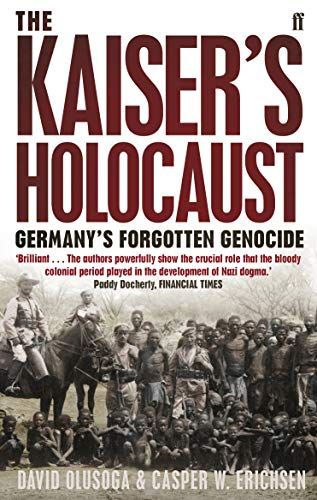
On 12 May 1883, the German flag was raised on the coast of South-West Africa, modern Namibia. As settlers began to take over the tribal lands of the indigenous peoples, the Herero and Nama resisted and Germany launched a war of extermination. It ended with the construction of concentration camps, in which prisoners were systematically worked and starved to death. Years later, the soldiers and bureaucrats who had administered the camps, and the racial theories that had inspired them, would play a role in the formation of Nazism.
David Olusoga and Casper W. Erichsen have uncovered extraordinary links between the Nazis and the atrocities committed in Africa under Kaiser Wilhelm. The infamous brown shirts worn by the Nazi storm troopers were colonial uniforms, originally designed as camouflage for the desert sand. The memory of Germany's African empire was revived as inspiration for the Nazi's wartime empire in the European East. Using shocking new archival evidence, The Kaiser's Holocaust is the definitive account of a genocide that was deliberately concealed for a century - a history that modern Germany has not yet come to terms with. Today, as the graves of the victims are uncovered in the Namibian deserts, the re-emergence of the Kaiser's holocaust poses a profound challenge to the notion that Nazi violence was an aberration in European history.
| Author | David Olusoga; Casper W. Erichsen |
|---|---|
| Publisher | Faber & Faber |
| Place | London |
| Year | 2011 |
| ISBN | 9780571231423 |
| Binding | Paperback |
| Condition | Very Good |
How we describe the condition of our books
We are very proud of the condition of the books we sell (please read our testimonials to find out more!)
New: Exactly as it says.
As New: Pretty much new but shows small signs of having been read; inside it will be clean without any inscriptions or stamps; might contain a remainder mark.
Very Good: Might have some creases on the spine; no hard cracks; maybe slight forward lean and short inscription inside; perhaps very minor bumping on the corners of the book; inside clean but the page edges might be slightly yellowed.
Good: A few creases on the spine, perhaps a forward lean, bumping on corners or shelfwear; maybe an inscription inside or some shelfwear or a small tear or two on the dustjacket; inside clean but page edges might be somewhat yellowed.
Fair: In overall good condition, might have a severe forward lean to the spine, an inscription, bumping to corners; one or two folds on the covers and yellowed pages; in exceptional cases these books might contain some library stamps and stickers or have neat sticky tape which was used to fix a short, closed tear.
Poor: We rarely sell poor condition books, unless the books are in demand and difficult to find in a better condition. Poor condition books are still perfect for a good read, all pages will be intact and none threatening to fall out; most probably a reading copy only.