
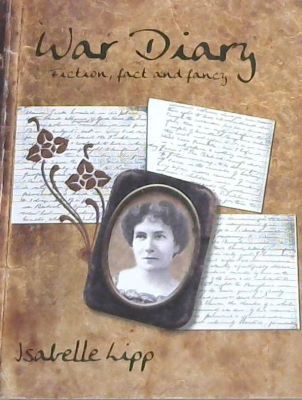
War Diary: Fiction, Fact and Fancy

 Share
Share
At the time of the declaration of war Isabelle and her husband. Charles, were in Johannesburg. He was manager of the Johannesburg branch of the African Banking Corporation and a British subject. All British subjects were required to leave the Zuid Afrikaansche (Transvaal) Republiek, but he and his wife were granted permits to remain in Johannesburg. Clearly it was the intention of the Government to allow banks to continue to operate, so their key personnel had to remain. They moved from their home in the suburbs and occupied rooms on the top floor of the Bank's premises. Mrs Lipp was determined to remain and support her husband, but they sent their children to the coast with relatives.
The Diary was kept for the period immediately before the granting of the Ultimatum by the British Government until the occupation of the British troops under Lord Roberts on 31 May 1900 - a period of just under eight months. The original handwritten diary was deposited with the University of Stellenbosch, together with a typed version which appears to have been completed in 1928. The typed version has been in circulation but, about five years ago, the Parktown & Westcliff Heritage Trust decided to publish the original version.
While attempting to retain the original text of the time, some editorial changes have been made to structure the sentences and paragraphs to assist the reader. Some changes had been made in the 1928 typed version. In cases where these assisted in expanding on the original text, they have been incorporated. Parts of the original text have been either damaged or are difficult to read. In these cases the later draft has been used.
| Author | Isabelle Eliza Lipp |
|---|---|
| Publisher | The Parktown & Westcluff Heritage Trust |
| Place | Johannesburg |
| Year | 2010 |
| ISBN | 9780620473972 |
| Binding | Paperback |
| Condition | Good |
How we describe the condition of our books
We are very proud of the condition of the books we sell (please read our testimonials to find out more!)
New: Exactly as it says.
As New: Pretty much new but shows small signs of having been read; inside it will be clean without any inscriptions or stamps; might contain a remainder mark.
Very Good: Might have some creases on the spine; no hard cracks; maybe slight forward lean and short inscription inside; perhaps very minor bumping on the corners of the book; inside clean but the page edges might be slightly yellowed.
Good: A few creases on the spine, perhaps a forward lean, bumping on corners or shelfwear; maybe an inscription inside or some shelfwear or a small tear or two on the dustjacket; inside clean but page edges might be somewhat yellowed.
Fair: In overall good condition, might have a severe forward lean to the spine, an inscription, bumping to corners; one or two folds on the covers and yellowed pages; in exceptional cases these books might contain some library stamps and stickers or have neat sticky tape which was used to fix a short, closed tear.
Poor: We rarely sell poor condition books, unless the books are in demand and difficult to find in a better condition. Poor condition books are still perfect for a good read, all pages will be intact and none threatening to fall out; most probably a reading copy only.