
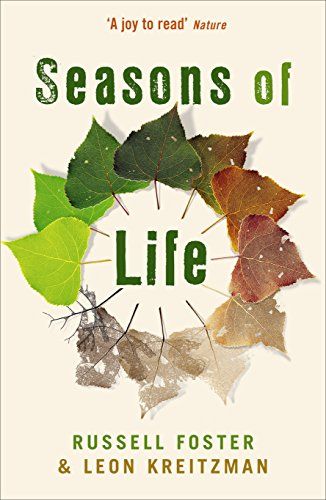
Seasons of Life: The Biological Rhythms That Enable Living Things to Thrive and Survive




 Share
Share
Just as daily events are timed by living creatures through circadian rhythms, so seasonal events are timed through an internal calendar that signals birds to return to nesting grounds, salmon to spawn, plants to flower, squirrels to hibernate, kelp to stop growing. In this fascinating book, Russell G. Foster and Leon Kreitzman draw on remarkable recent scientific advances to explain how seasonal change affects organisms, and how plants and animals over countless generations have evolved exquisite sensitivities and adaptations to the seasons. The authors also highlight the impact of seasonal change on human health and well-being. They conclude with a discussion of the dangers posed when climate changes disrupt the seasonal rhythms on which so much life depends. Surprising facts from Seasons of Life :
–The timing of human birth has a small but significant effect on various later life attributes, such as handedness and the susceptibility to many illnesses, including multiple sclerosis and schizophrenia.
–Plants have the ability to measure the length of a period of light, and they germinate, flower, and successfully reproduce by using this information.
–Birds migrate not in response to weather changes but by using an internal calendar.
–Until recently, human birth was tightly coupled to the seasons, peaking in many societies in the spring.
–Just as internal 24-hour circadian clocks predict daily change, many animals have a circannual clock in their brains that predicts the seasons.
| Author | Russell G. Foster |
|---|---|
| Publisher | Profile Books |
| Place | London |
| Year | 2009 |
| ISBN | 9781861979148 |
| Binding | Hardcover |
| Condition | Very Good |
| Dustjacket Condition | Very Good |
| Comments | Appears to be signed by both authors; slight twist in spine. |
How we describe the condition of our books
We are very proud of the condition of the books we sell (please read our testimonials to find out more!)
New: Exactly as it says.
As New: Pretty much new but shows small signs of having been read; inside it will be clean without any inscriptions or stamps; might contain a remainder mark.
Very Good: Might have some creases on the spine; no hard cracks; maybe slight forward lean and short inscription inside; perhaps very minor bumping on the corners of the book; inside clean but the page edges might be slightly yellowed.
Good: A few creases on the spine, perhaps a forward lean, bumping on corners or shelfwear; maybe an inscription inside or some shelfwear or a small tear or two on the dustjacket; inside clean but page edges might be somewhat yellowed.
Fair: In overall good condition, might have a severe forward lean to the spine, an inscription, bumping to corners; one or two folds on the covers and yellowed pages; in exceptional cases these books might contain some library stamps and stickers or have neat sticky tape which was used to fix a short, closed tear.
Poor: We rarely sell poor condition books, unless the books are in demand and difficult to find in a better condition. Poor condition books are still perfect for a good read, all pages will be intact and none threatening to fall out; most probably a reading copy only.