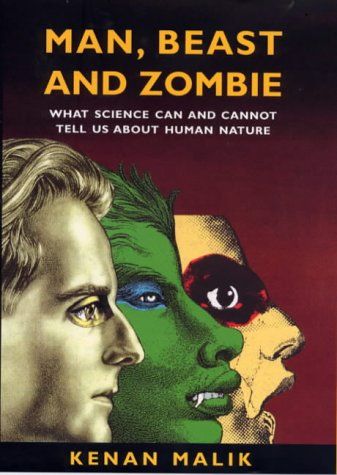
Man, Beast and Zombie: What Science Can and Cannot Tell Us about Human Nature


 Share
Share
A fascinating examination of what science can and cannot explain about human nature.
Are humans unique? Can animals think as we do? Will machines ever have consciousness? What is free will? For centuries, attempts to answer these questions have been the stuff of both bar-room debates and intense theological and philosophical dispute. Now scientists claim they can solve these riddles of human existence once and for all. In so doing, they promise to upset many of the accepted ideas about morality and human nature.
Man, Beast, and Zombie is an original and accessible book. Vast in its scope, it draws on cutting-edge sciences such as evolutionary biology, cognitive psychology, and artificial intelligence to assess what, precisely, science can and cannot explain about human nature. Kenan Malik explains the histories of these sciences (and the philosophies that underpin them) and analyzes the complex relationship between human beings, animals, and machines to explore what really makes us human.
Malik demonstrates that much current thinking about human nature is flawed: how there is more than one way to design a mind; why the lifestyles of contemporary hunter-gatherers do not illuminate the lives of our prehistoric ancestors; and what intelligent machines really reveal about human consciousness. He shows, too, how the scientific debate about human nature is as influenced by politics as by science.
Man, Beast, and Zombie is both a defense of scientific reason and a challenge to some of todays most cherished scientific theories. It deftly interweaves philosophy, science, and history to answer the most fundamental question of all: what is a human being?
| Author | Kenan Malik |
|---|---|
| Publisher | Phoenix |
| Place | London |
| Year | 2001 |
| ISBN | 9780753812952 |
| Binding | Paperback |
| Condition | Very Good |
How we describe the condition of our books
We are very proud of the condition of the books we sell (please read our testimonials to find out more!)
New: Exactly as it says.
As New: Pretty much new but shows small signs of having been read; inside it will be clean without any inscriptions or stamps; might contain a remainder mark.
Very Good: Might have some creases on the spine; no hard cracks; maybe slight forward lean and short inscription inside; perhaps very minor bumping on the corners of the book; inside clean but the page edges might be slightly yellowed.
Good: A few creases on the spine, perhaps a forward lean, bumping on corners or shelfwear; maybe an inscription inside or some shelfwear or a small tear or two on the dustjacket; inside clean but page edges might be somewhat yellowed.
Fair: In overall good condition, might have a severe forward lean to the spine, an inscription, bumping to corners; one or two folds on the covers and yellowed pages; in exceptional cases these books might contain some library stamps and stickers or have neat sticky tape which was used to fix a short, closed tear.
Poor: We rarely sell poor condition books, unless the books are in demand and difficult to find in a better condition. Poor condition books are still perfect for a good read, all pages will be intact and none threatening to fall out; most probably a reading copy only.