
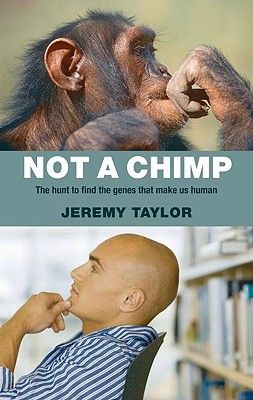
Not a Chimp: The Hunt to Find the Genes that Make Us Human



 Share
Share
In Not a Chimp, Jeremy Taylor describes one of the great scientific quests of our times--the effort to discover precisely what makes humans different from other primates, especially our closest evolutionary relative, the chimpanzee. Drawing on state-of-the-art science, Taylor convincingly debunks the assertion that our two species are nearly identical genetically. He sketches the picture now emerging from cutting-edge research in genetics, animal behavior, and other fields to show that the so-called 1.6% difference is effectively much larger, leading to a profound divergence between the two species. Indeed, he explains that the evolution of the human genome has accelerated since the split of chimps and humans from a common ancestor more than six million years ago. In fact, at least 7% of human genes--almost one gene in ten--have accumulated changes within the last 50,000 years. Some of the genes that have changed orchestrate entire sets of other genes, and recent studies show that it is this complex interaction--rather than the action of individual genes--that underlies speech processes, brain development, and a host of other mechanisms that make humans unique.
We humans are far different, genetically speaking, than chimps. More than that, we have been the architects of our own evolution through the same processes that have produced our farm animals and crop plants. We are the apes that domesticated themselves.
"Should be mandatory reading for journalists who often reinforce the general public's misconception that chimps are practically human."
--New Scientist
| Author | Jeremy Taylor |
|---|---|
| Publisher | Oxford University Press |
| Place | London |
| Year | 2010-06-25 |
| ISBN | 9780199227792 |
| Binding | Paperback |
| Condition | Very Good |
How we describe the condition of our books
We are very proud of the condition of the books we sell (please read our testimonials to find out more!)
New: Exactly as it says.
As New: Pretty much new but shows small signs of having been read; inside it will be clean without any inscriptions or stamps; might contain a remainder mark.
Very Good: Might have some creases on the spine; no hard cracks; maybe slight forward lean and short inscription inside; perhaps very minor bumping on the corners of the book; inside clean but the page edges might be slightly yellowed.
Good: A few creases on the spine, perhaps a forward lean, bumping on corners or shelfwear; maybe an inscription inside or some shelfwear or a small tear or two on the dustjacket; inside clean but page edges might be somewhat yellowed.
Fair: In overall good condition, might have a severe forward lean to the spine, an inscription, bumping to corners; one or two folds on the covers and yellowed pages; in exceptional cases these books might contain some library stamps and stickers or have neat sticky tape which was used to fix a short, closed tear.
Poor: We rarely sell poor condition books, unless the books are in demand and difficult to find in a better condition. Poor condition books are still perfect for a good read, all pages will be intact and none threatening to fall out; most probably a reading copy only.