
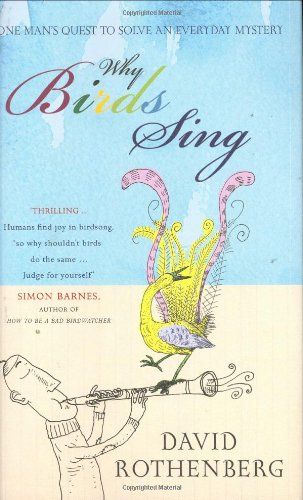
Why Birds Sing: One Man's Quest to Solve an Everyday Mystery

 Share
Share
The astonishing richness of birdsong is both an aesthetic and a scientific mystery. Evolutionists have never been able to completely explain why birdsong is so inventive and why many species devote so many hours to singing. The standard explanations of defending territories and attracting mates don't begin to account for the variety and energy that the commonest birds exhibit. Is it possible that birds sing because they like to? This seemingly naive explanation is starting to look more and more like the truth. Why Birds Sing is a lyric exploration of birdsong that blends the latest scientific research with a deep understanding of musical beauty and form. Drawing on conversations with neuroscientists, ecologists, and composers, it is the first book to investigate the elusive question of why birds sing and what their song means to both avian and human ears. Whether playing his clarinet with the white crested laughing thrush in Pittsburgh, or jamming in the Australian winter breeding grounds of the Albert's lyrebird, Rothenberg immerses himself in the heart and soul of birdsong. He approaches the subject as a naturalist, philosopher, musician, and investigator. An intimate look at the most lovely of natural phenomena, Why Birds Sing is a beautifully written exploration of a phenomenon that's at once familiar and profoundly alien.
*DJ rubbed & handling marks*| Author | David Rothenberg |
|---|---|
| Publisher | Penguin Books |
| Place | London |
| Year | 2005 |
| ISBN | 9780713998290 |
| Binding | Hardcover |
| Condition | Very Good |
| Dustjacket Condition | Good |
| Comments | DJ rubbed & handling marks |
How we describe the condition of our books
We are very proud of the condition of the books we sell (please read our testimonials to find out more!)
New: Exactly as it says.
As New: Pretty much new but shows small signs of having been read; inside it will be clean without any inscriptions or stamps; might contain a remainder mark.
Very Good: Might have some creases on the spine; no hard cracks; maybe slight forward lean and short inscription inside; perhaps very minor bumping on the corners of the book; inside clean but the page edges might be slightly yellowed.
Good: A few creases on the spine, perhaps a forward lean, bumping on corners or shelfwear; maybe an inscription inside or some shelfwear or a small tear or two on the dustjacket; inside clean but page edges might be somewhat yellowed.
Fair: In overall good condition, might have a severe forward lean to the spine, an inscription, bumping to corners; one or two folds on the covers and yellowed pages; in exceptional cases these books might contain some library stamps and stickers or have neat sticky tape which was used to fix a short, closed tear.
Poor: We rarely sell poor condition books, unless the books are in demand and difficult to find in a better condition. Poor condition books are still perfect for a good read, all pages will be intact and none threatening to fall out; most probably a reading copy only.