
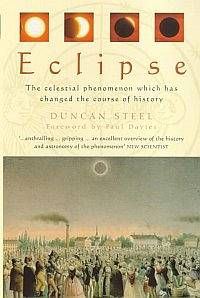
Eclipse: The Celestial Phenomenon Which Has Changed The Course Of History

 Share
Share
In August 1999, for the first time in more than 70 years, the northern hemisphere will experience a total eclipse of the sun. This book is an engaging, accessible and authoritative account of this phenomenon and how it has affected humanity from the beginning of time. Author is Adelaide-based director of Spaceguard Australia.
Ancient peoples were clearly disconcerted by them. The Romans marked pivotal battles with the Greeks by references to an eclipse. The date of the crucifixion of Jesus Christ has been derived by using biblical mentions of an eclipse. Perhaps most famously, Christopher Columbus extorted much-needed foodstuffs from some increasingly unfriendly native hosts by purporting to demonstrate the wrath of his most powerful God when he accurately predicted a lunar eclipse.
The pattern that eclipses followa "a cycle, called the sarosa "was actually calculated thousands of years ago. However, it is only with the help of modern computers that we have been able to analyze and appreciate the data. Eclipses provide unique opportunities for todaya (TM)s scientists to study such contrasting phenomena as the upper layers of the sun, the slowdown of our planeta (TM)s spin rate, and the effects of celestial events on human psychology.
In Eclipse, Duncan Steel expertly captures our continuing fascination with all manner of eclipsesa "including the familiar solar and lunar varieties and other kinds involving stars, planets, asteroids, and comets as well as distant galaxies and quasars. Steel helps us see that, in astronomical terms, eclipses are really rather straightforward affairs. Moving beyond the mysticism and the magic, the science of eclipses is revealed.
*Bottom right corner a bit bumped.*
| Author | Duncan Steel |
|---|---|
| Publisher | Headline |
| Place | London |
| Year | 2000 |
| ISBN | 9780747262848 |
| Binding | Paperback |
| Condition | Good |
| Comments | Bottom right corner a bit bumped. |
How we describe the condition of our books
We are very proud of the condition of the books we sell (please read our testimonials to find out more!)
New: Exactly as it says.
As New: Pretty much new but shows small signs of having been read; inside it will be clean without any inscriptions or stamps; might contain a remainder mark.
Very Good: Might have some creases on the spine; no hard cracks; maybe slight forward lean and short inscription inside; perhaps very minor bumping on the corners of the book; inside clean but the page edges might be slightly yellowed.
Good: A few creases on the spine, perhaps a forward lean, bumping on corners or shelfwear; maybe an inscription inside or some shelfwear or a small tear or two on the dustjacket; inside clean but page edges might be somewhat yellowed.
Fair: In overall good condition, might have a severe forward lean to the spine, an inscription, bumping to corners; one or two folds on the covers and yellowed pages; in exceptional cases these books might contain some library stamps and stickers or have neat sticky tape which was used to fix a short, closed tear.
Poor: We rarely sell poor condition books, unless the books are in demand and difficult to find in a better condition. Poor condition books are still perfect for a good read, all pages will be intact and none threatening to fall out; most probably a reading copy only.