
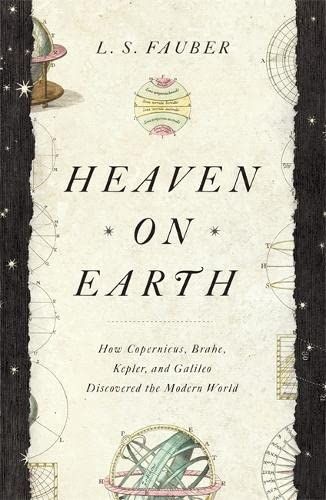
Heaven on Earth: How Copernicus, Brahe, Kepler, and Galileo Discovered the Modern World






 Share
Share
Today we take for granted that a telescope allows us to see galaxies millions of light years away. But before its invention, people used nothing more than their naked eye to fathom what took place in the visible sky. So how did four men in the 1500's—of different nationality, age, religion, and class—collaborate to discover that the Earth revolved around the Sun? With this radical discovery that went against the Church, they created our contemporary world—and with it, the uneasy conditions of modern life.
Heaven on Earth is an intimate examination of this scientific family—that of Nicolaus Copernicus, Tycho Brahe, Johannes Kepler, and Galileo Galilei. Fauber juxtaposes their scientific work with insight into their personal lives and political considerations, which shaped their pursuit of knowledge. Uniquely, he shows how their intergenerational collaboration was actually what made the scientific revolution possible. Ranging from the birth of astronomy and the methods of early scientific research, Fauber reveals the human story that underlies this civilization altering discovery. And, contrary to the competitive nature of research today, collaboration was key to early scientific discovery. Before the rise of university research institutions, deep thinkers only had each other. They created a kind of family, related to each other via intellectual pursuit rather than blood.These men called each other “brothers,” “fathers,” and “sons,” and laid the foundations of modern science through familial co-work. And though the sixteenth century was far from the an open society for women, There were female pioneers in this “family” as well, including Brahe's sister Sophie, Kepler’s mother, and Galileo's daughter.Filled with rich characters and sweeping historical scope, Heaven on Earth reveals how the strong connections between these pillars of intellectual history moved science forward—and how, without them, we might have waited a long time for a heliocentric model of the universe.
| Author | L. S. Fauber |
|---|---|
| Publisher | Coronet |
| Place | London |
| Year | 2019-12-12 |
| ISBN | 9781529362206 |
| Binding | Paperback |
| Condition | Very Good |
How we describe the condition of our books
We are very proud of the condition of the books we sell (please read our testimonials to find out more!)
New: Exactly as it says.
As New: Pretty much new but shows small signs of having been read; inside it will be clean without any inscriptions or stamps; might contain a remainder mark.
Very Good: Might have some creases on the spine; no hard cracks; maybe slight forward lean and short inscription inside; perhaps very minor bumping on the corners of the book; inside clean but the page edges might be slightly yellowed.
Good: A few creases on the spine, perhaps a forward lean, bumping on corners or shelfwear; maybe an inscription inside or some shelfwear or a small tear or two on the dustjacket; inside clean but page edges might be somewhat yellowed.
Fair: In overall good condition, might have a severe forward lean to the spine, an inscription, bumping to corners; one or two folds on the covers and yellowed pages; in exceptional cases these books might contain some library stamps and stickers or have neat sticky tape which was used to fix a short, closed tear.
Poor: We rarely sell poor condition books, unless the books are in demand and difficult to find in a better condition. Poor condition books are still perfect for a good read, all pages will be intact and none threatening to fall out; most probably a reading copy only.