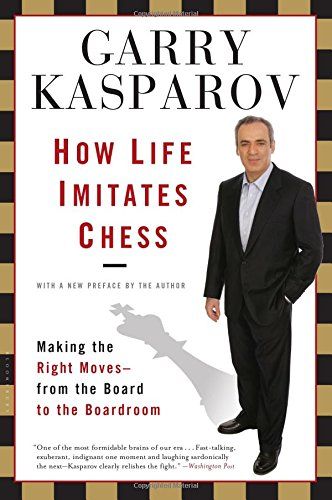
"One of the most formidable brains of our era....fast-talking, exuberant, indigant one moment and laughing sardonically the next - Kasparov clearly relishes the fight."-Washington Post Garry Kasparov was the highest-rated chess player in the world for over twenty years and is widely considered the greatest player that ever lived. In How Life Imitates Chess Kasparov distills the lessons he learned over a lifetime as a Grandmaster to offer a primer on successful decision-making: how to evaluate opportunities, anticipate the future, devise winning strategies. He relates in a lively, original way all the fundamentals, from the nuts and bolts of strategy, evaluation, and preparation to the subtler, more human arts of developing a personal style and using memory, intuition, imagination and even fantasy. Kasparov takes us through the great matches of his career, including legendary duels against both man (Grandmaster Anatoly Karpov) and machine (IBM chess supercomputer Deep Blue), enhancing the lessons of his many experiences with examples from politics, literature, sports and military history. With candor, wisdom, and humor, Kasparov recounts his victories and his blunders, both from his years as a world-class competitor as well as his new life as a political leader in Russia. An inspiring book that combines unique strategic insight with personal memoir, How Life Imitates Chess is a glimpse inside the mind of one of today's greatest and most innovative thinkers. Editorial Reviews Amazon.com Review In his 22-year reign as Grandmaster, Garry Kasparov faced more than a few tough choices under the heat of chess competitons. This is a man who knows a thing or two about making smart decisions, and since his retirement in 2005, Kasparov has put his powerful strategic thinking to work in business and politics, showing that a simple reliance on instincts can guide you through even the most complex challenges. With no shortage of wit or eloquence, he's answered our hardest questions about what factors can make or break a decision-making moment. --Anne Bartholomew Questions for Garry Kasparov Amazon.com: Why do you think decisiveness is such an elusive skill for people to master? Are there simply too many choices? What's a good first step for negotiating your options? Kasparov: It's true that today we are faced with greater complexity in almost every aspect of our lives, from global competition in the business world to more options for entertainment. The connected world has flooded us with a limitless supply of data, and equally limitless choices. One of the problems this has created is that it creates the illusion, or delusion, that we can achieve perfection in our decisions by accumulating more information. It's too easy to blame faulty decisions on imperfect information, but information is always limited in some way, as is the time available to make our decisions. Forget perfection! Decisiveness comes from the courage to trust your instincts. The more you trust, the more you'll build up that intuition and the more accurate it will become, creating a positive cycle. Before you lay out your options, what we might call considering your next move, you have to have a solid understanding of the present. Evaluation is more important than calculation. Rushing into narrowing things down to a list of options is itself a form of making a choice -- and if you do that, you can prematurely rule out important possibilities. Stop looking ahead for a moment and examine the current state of affairs. Good decisions come from a solid understanding of all the factors that come into play. Once you have tuned your evaluation skills and learned to put the options on hold for a moment you'll often find that difficult decisions become obvious. Amazon.com: Taking a holistic view of your career, do you recall the moment you identified your talent for thinking strategically? Is it possible for you to separate that sense of yourself from your identity as a chess champion? Kasparov: In the world of competitive chess, or any sport for that matter, everything is relative. Your results tell you about your talent. How can you identify a talent that goes untested? That's one reason I'm so passionate about trying new things and about encouraging others to leave their comfort zones. I was fortunate in that my status as world champion brought me into contact with world leaders, top executives, authors, and other luminaries. I very much enjoyed these exchanges, learning about these other worlds. It also gave me the chance to share my own thoughts, something I've never been shy about doing. I'm sure they had to humor my impetuousness on occasion! But often they encouraged me and I discovered I had a knack for making unusual connections, a way of seeing the big picture that wasn't limited to the chessboard. Until my retirement from chess in March 2005 it would have been nearly impossible for me to separate myself from my chess identity--other than love for family and friends. But since then I have moved into several entirely different worlds. I'm at the table as a politician, or writing editorials, or lecturing about strategy and intuition in front of business audiences. My former chess career still precedes me in these settings, but they aren't humoring me anymore! Actually, the biggest step was working on this book, which forced me to consider the mechanics of my own mind beyond chess. I had to ask myself if I really had something to offer and then figure out how to express it concretely. The positive reactions of my lecture audiences also helped in this regard. Amazon.com: Playing chess competitively no doubt requires huge reserves of passion, patience, and discipline. For those readers who haven't experienced the kind of rigorous training that competitive chess imparts, can you recommend some good ways to practice strategic thinking? Kasparov: We all do it every day, the difference is that it takes discipline to become aware of it. In the book I ask the reader to consider all the significant decisions they made that day, that week. You don't have to be a chess player or an executive to benefit from improving your decision- making process. We make hundreds of decisions just to get through each day. A handful are important enough to keep track of, to look back on critically. Were they successful? Why or why not? We can train ourselves, which is really the only way. Amazon.com: Did you ever find during a particularly difficult match that it was hard to prevent your emotions from clouding your decision-making ability? What was your strategy for coping with stress or anxiety in that kind of situation? Kasparov: Emotion is a critical element of decision-making, not a sin always to be avoided. As with anything it is harmful in excess. You learn to focus it and control it the best you can. I'm a very emotional person in and out of chess so this was always a challenge for me. When I sat down at the board against my great rival, Anatoly Karpov, it was a special occasion. I knew it, he knew it, and we both knew the chess world was paying special attention. We had such a long and bitter history that it was impossible not to bring it to the board with us every time we played. On some occasions this anxiety created negative emotions like doubt. More often it generated greater creative tension, greater supplies of nervous tension, which is a chess player's lifeblood. Usually when you are under stress there is a good reason for it. Learning not to get anxious about things beyond your control is a separate issue. So don't fight stress, use it! Channel that nervous energy into solving the problems. Sitting around worrying isn't going to achieve anything and the loss of time will often make the problem worse. Even in the worst case, mistakes of action teach you much more than inaction. Forward! Amazon.com: If you could choose five people, living or dead, to play you in chess, who would they be? Kasparov: Don't you know I have retired as a chess player? Well, I will go with you to the middle with two and a half opponents. 4th world chess champion Alexander Alekhine (d. 1946) was my childhood chess idol. The book of his collected games was my constant companion. He was a player of limitless imagination and combativeness. Some aspects of his pre-WWII-era chess would be considered antique today, but his talent is timeless. Just sitting at the board with him to analyze and share ideas would be like a youthful dream made real. My next player requires a change of date as well, since I am now retired. In the period of 2001-2002 I felt I deserved a rematch against Vladimir Kramnik, who took my title in 2000. I was still the top-rated player in the world, the obvious top challenger. So I would choose a 16-game match against Kramnik--in 2002. Last on my list is a chessplayer who is most definitely dead. Even if chess has by now passed it by, I would take a tiebreaker match against Deep Blue. I won our first match; the machine won the second. Then IBM made sure there would be no chance for a rematch. This time everything would be out in the open, no black boxes. Of course chess machines are considerably stronger today. It would still be pleasant to gain revenge and set the record straight. (photo credit: Todd Plitt) --This text refers to an out of print or unavailable edition of this title. From Publishers Weekly With millions of serious chess players and Kasparov a regular in international news headlines, a business manual by the champion-turned-activist seems a no-brainer. Kasparov discusses each element of chess and strains to find parallels in life and the boardroom. Yet the book is surprisingly serious and readable, even if those who persevere won't necessarily be convinced that chess is an ideal laboratory for the decision-making process. While offering real insight into the game, Kasparov offers somewhat less into general decision making, urging readers to be aware of your routines, then break them and emphasizing both precise calculation and intuition and optimism. The author's attempts at chess metaphor are often a stretch: after all, chess matches are one-on-one and win-lose-draw, resembling war far more closely than anything in the boardroom. In fact, Kasparov's examples more often come from the battlefield than from business. Without a more direct business connection, his advice reverts to platitudes (To achieve success, our strategy must be implemented with accurate tactics). More engaging are the author's autobiographical anecdotes about his face-off against IBM's Deep Blue computer and his 2005 transition to becoming a full-time member of the Russian political opposition movement. Kasparov fans will find much to enjoy, but serious business readers should look elsewhere. (Oct.) Copyright ® Reed Business Information, a division of Reed Elsevier Inc. All rights reserved. --This text refers to an out of print or unavailable edition of this title.



 Share
Share