
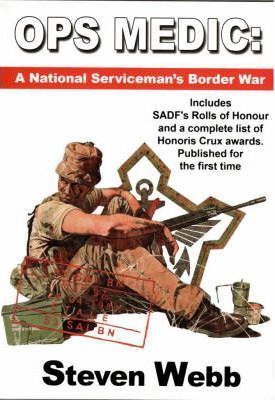
Ops Medic: A National Serviceman's Border War

 Share
Share
As a recent British immigrant the author was exempt from the compulsory two-year call-up for National Service that all white South African males faced when they turned 18. Despite this he volunteered for National Service in July 1984 and then volunteered to serve in the South African Medical Service. Following basic training he was posted to SAMS' Combat Medical Operation Company (Ops Company) for six months of advanced specialist training.
In the lecture room and later in civilian hospitals he learned the arts of stabilising patients, stopping bleeding, maintaining airways, suturing wounds, administering drips and performing minor lifesaving medical procedures. On 1 March 1985 he was sent to SWA/Namibia, where he saw service in Angola until the SADF withdrew its troops a month later. From there he was posted to 53-Battalion's company base at Etale. It was garrisoned by Owambo troops of the SWATF's 101-Battalion and white National Servicemen. He writes about border patrols conducted on foot and in Buffel mine protected fighting vehicles, seeking out SWAPO's armed guerrillas who had infiltrated from Angola and the constant anticipation of ambush by an elusive foe.He tells of the stabilisation and casevac of casualties by helicopter.
In truth white National Service units achieved little success in the border war against an underrated enemy. As one senior officer put it: 'In my view SWAPO, despite inferior weaponry, was ahead of us in most respects. We took a boy who had just matriculated, gave him a gun, two or three months of basic training - and threw him into the middle of a country that he didn't know, people he didn't understand and an enemy he had never seen. No wonder he didn't do very well. Nevertheless, the young conscripts bore a terrible load, for which they received little gratitude.'
So this is not the story of elite and glamorous fighting units like the Reconnaissance Commandos, Koevoet, 32-Battalion, or the Parachute Battalions and the successes they achieved, but of young, white, conscripted National Serviceman, often straight from school, who were thrown headfirst into a guerrilla war in a country outside of South Africa and far from home. Many National Servicemen, including 37 Ops Medics, died fighting in the Border War. Fifteen were awarded the Honoris Crux (two of the silver grade) for bravery - four posthumously.
| Author | Steven Webb |
|---|---|
| Publisher | Galago |
| Place | Alberton |
| Year | 2008 |
| ISBN | 9781919854298 |
| Binding | Paperback |
| Condition | Good |
| Comments | Corners slightly bumped. |
How we describe the condition of our books
We are very proud of the condition of the books we sell (please read our testimonials to find out more!)
New: Exactly as it says.
As New: Pretty much new but shows small signs of having been read; inside it will be clean without any inscriptions or stamps; might contain a remainder mark.
Very Good: Might have some creases on the spine; no hard cracks; maybe slight forward lean and short inscription inside; perhaps very minor bumping on the corners of the book; inside clean but the page edges might be slightly yellowed.
Good: A few creases on the spine, perhaps a forward lean, bumping on corners or shelfwear; maybe an inscription inside or some shelfwear or a small tear or two on the dustjacket; inside clean but page edges might be somewhat yellowed.
Fair: In overall good condition, might have a severe forward lean to the spine, an inscription, bumping to corners; one or two folds on the covers and yellowed pages; in exceptional cases these books might contain some library stamps and stickers or have neat sticky tape which was used to fix a short, closed tear.
Poor: We rarely sell poor condition books, unless the books are in demand and difficult to find in a better condition. Poor condition books are still perfect for a good read, all pages will be intact and none threatening to fall out; most probably a reading copy only.