
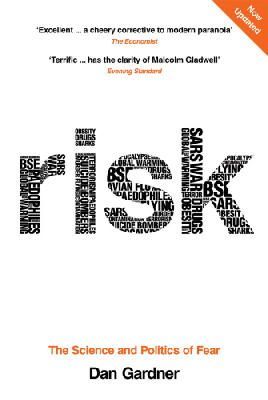
Risk: The Science and Politics of Fear



 Share
Share
In the tradition of Malcolm Gladwell, Gardner explores a new way of thinking about the decisions we make.
We are the safest and healthiest human beings who ever lived, and yet irrational fear is growing, with deadly consequences — such as the 1,595 Americans killed when they made the mistake of switching from planes to cars after September 11. In part, this irrationality is caused by those — politicians, activists, and the media — who promote fear for their own gain. Culture also matters. But a more fundamental cause is human psychology.
Working with risk science pioneer Paul Slovic, author Dan Gardner sets out to explain in a compulsively readable fashion just what that statement above means as to how we make decisions and run our lives. We learn that the brain has not one but two systems to analyze risk. One is primitive, unconscious, and intuitive. The other is conscious and rational. The two systems often agree, but occasionally they come to very different conclusions. When that happens, we can find ourselves worrying about what the statistics tell us is a trivial threat — terrorism, child abduction, cancer caused by chemical pollution — or shrugging off serious risks like obesity and smoking.
Gladwell told us about “the black box” of our brains; Gardner takes us inside, helping us to understand how to deconstruct the information we’re bombarded with and respond more logically and adaptively to our world. Risk is cutting-edge reading.
| Author | Dan Gardner |
|---|---|
| Publisher | Virgin Books |
| Place | London |
| Year | 2009 |
| ISBN | 9780753515532 |
| Binding | Paperback |
| Condition | Good |
How we describe the condition of our books
We are very proud of the condition of the books we sell (please read our testimonials to find out more!)
New: Exactly as it says.
As New: Pretty much new but shows small signs of having been read; inside it will be clean without any inscriptions or stamps; might contain a remainder mark.
Very Good: Might have some creases on the spine; no hard cracks; maybe slight forward lean and short inscription inside; perhaps very minor bumping on the corners of the book; inside clean but the page edges might be slightly yellowed.
Good: A few creases on the spine, perhaps a forward lean, bumping on corners or shelfwear; maybe an inscription inside or some shelfwear or a small tear or two on the dustjacket; inside clean but page edges might be somewhat yellowed.
Fair: In overall good condition, might have a severe forward lean to the spine, an inscription, bumping to corners; one or two folds on the covers and yellowed pages; in exceptional cases these books might contain some library stamps and stickers or have neat sticky tape which was used to fix a short, closed tear.
Poor: We rarely sell poor condition books, unless the books are in demand and difficult to find in a better condition. Poor condition books are still perfect for a good read, all pages will be intact and none threatening to fall out; most probably a reading copy only.