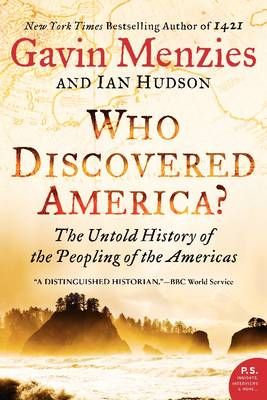
Who Discovered America? The Untold History of the Peopling of the Americas
R78.00
Out of stock
SKU
43179
Share
Login to earn BookBucks for sharing!
Updated with astonishing new findings A groundbreaking history that upends our understanding of ancient America From Gavin Menzies, the author of the blockbuster New York Times bestseller 1421, comes a revolutionary new account of how the first humans came to North and South America. Menzies reveals that ancient peoples used the oceans' natural currents and prevailing winds to make voyages across both the Atlantic and Pacific. What's more, we now must accept that they had time to develop remarkably advanced cultures. Armed with cutting-edge DNA evidence, newly unearthed artifacts, and astonishing linguistic and archaeological discoveries, Menzies shows: humans have been making transoceanic voyages as far back as 100,000 years ago, vastly predating the supposed overland migration to the Americas during the last Ice Age; the ancient South American civilizations of the Olmec and Maya in Central and South America may have had direct origins and influences from Asia; ancient maps held in the Library of Congress in Washington, D.C., show there must have been sustained and dedicated voyages to the Western Hemisphere by Chinese explorers as early as 2200 b.c.; huge Chinese settlements occupied (and made exploratory journeys from) Nova Scotia; Japanese, Korean, and European voyages predated the explorations currently recorded by history. A maverick scholar, Menzies has made a riveting new contribution to the story of humanity’s earliest explorers, revealing the truth behind one of history’s most fascinating questions: Who discovered America?
More Information
AuthorGavin Menzies
PublisherWilliam Morrow Paperbacks
PlaceLondon
Year2014-11-25
ISBN9780062236784
BindingPaperback
ConditionGood
0
Rating:
0% of 100
Write Your Own Review
Only registered users can write reviews. Please Sign in or create an account

How we describe the condition of our books

We are very proud of the condition of the books we sell (please read our testimonials to find out more!)

New: Exactly as it says.

As New: Pretty much new but shows small signs of having been read; inside it will be clean without any inscriptions or stamps; might contain a remainder mark.

Very Good: Might have some creases on the spine; no hard cracks; maybe slight forward lean and short inscription inside; perhaps very minor bumping on the corners of the book; inside clean but the page edges might be slightly yellowed.

Good: A few creases on the spine, perhaps a forward lean, bumping on corners or shelfwear; maybe an inscription inside or some shelfwear or a small tear or two on the dustjacket; inside clean but page edges might be somewhat yellowed.

Fair: In overall good condition, might have a severe forward lean to the spine, an inscription, bumping to corners; one or two folds on the covers and yellowed pages; in exceptional cases these books might contain some library stamps and stickers or have neat sticky tape which was used to fix a short, closed tear.

Poor: We rarely sell poor condition books, unless the books are in demand and difficult to find in a better condition. Poor condition books are still perfect for a good read, all pages will be intact and none threatening to fall out; most probably a reading copy only.